

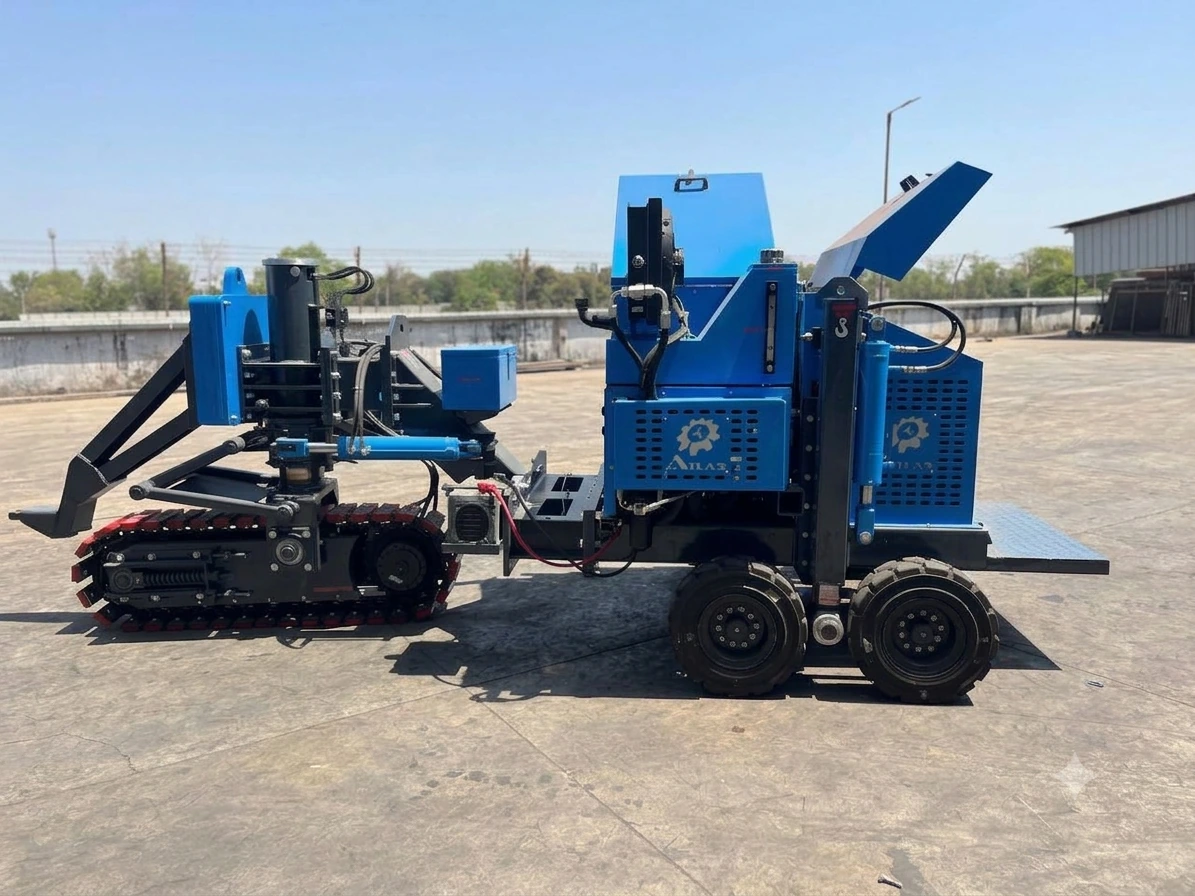
Long stretches of concrete kerbs require consistent alignment, profile accuracy, and a steady pace of construction. Conventional methods can involve repeated formwork, manual placement, and greater dependence on site labour.
A concrete paver mechanises this process by placing and shaping concrete as it moves along the required alignment.
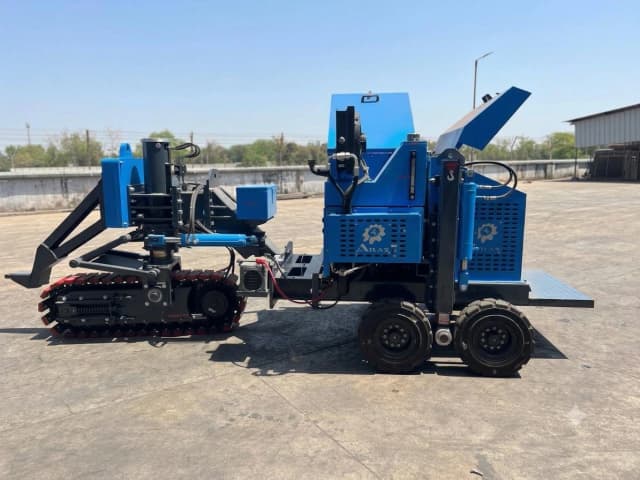
For kerb construction, the machine is commonly known as a kerb laying machine or kerb paver.
This article explains how it works, the main machine types, and when it makes sense to use one.
What Is a Concrete Paver?
A concrete paver is a self-propelled machine that shapes fresh concrete into a defined profile without requiring fixed forms along the full length of the work.
Concrete is fed into the machine, consolidated by vibration, and shaped in a mould. As the machine moves forward, the formed concrete profile is placed behind it.
Depending on the mould, the machine can produce:
- Road kerbs
- Raised medians
- Traffic separators
- Road edging
- Drainage channels
- Other continuous concrete profiles
When configured specifically for kerb construction, it is commonly referred to as a concrete kerb laying machine.
How Does a Kerb Laying Machine Work?
The process follows a continuous sequence:
- Concrete is supplied to the machine hopper.
- The material is directed into the selected mould.
- Internal vibration consolidates the concrete during placement.
- The mould forms the required cross-section.
- The machine advances along the alignment, leaving the finished profile behind.
The mould determines the shape, while the machine's steering and guidance systems help maintain the required line and level.
For consistent results, two factors are particularly important: a concrete mix suitable for slip-form placement and a reliable supply of material throughout the operation.
Atlas Kerb Laying vs Traditional Kerb Laying
The key difference is the method used to form and place the kerb.
| Parameter | Traditional Kerb Laying | Atlas Kerb Laying Machine |
|---|---|---|
| Construction method | Individual units or sectional formwork | Machine-based continuous placement |
| Labour involvement | Higher during placement and formwork | Lower during placement |
| Alignment | Relies more heavily on manual setting | Based on a sensor that signals the machine control. |
| Productivity | Depends on formwork and labour cycle | Depends on machine operation and concrete supply |
| Profile options | Requires separate units or forms | Changed through mould selection |
| Suitable work | Shorter or localised sections | Longer, repetitive kerb work |
Neither method is universally better. The choice depends on the volume of kerb work, required profiles, site conditions and project programme.
Types of Concrete Kerb Laying Machines
Concrete machines are available in different sizes depending on the scale and complexity of the work.
Compact Kerb Laying Machines
Smaller machines are suited to projects where manoeuvrability, easier transport and operation in restricted areas are important.
Typical applications include:
- Urban road work
- Road edging
- Landscaping
- Smaller infrastructure projects
- Restricted-access locations
Atlas Technologies' XL-400 is designed for this category of concrete profile work.
Higher-Capacity Kerb Laying Machines
Larger machines are intended for longer stretches and projects requiring greater control over line, level and grade.
Atlas Technologies' XL-550 is equipped with a 27 kW (36 HP) water-cooled diesel engine, hydrostatic drive and automatic electronic line, grade and level controls.
Its side-mounted mould arrangement allows profile changes in approximately 30 minutes, depending on site and operating conditions.
Typical applications include:
- Highway kerbs
- Long median sections
- Airport infrastructure
- Major urban road projects
Match the Machine to Your Kerb Work
Tell Atlas Technologies about your required kerb profile, project length and operating conditions. We can help you identify a suitable machine and mould configuration for the application.
Get Machine Details →Where Can a Concrete Paver Be Used?
With the appropriate mould, a concrete kerb paver can be used for several continuous concrete applications.
| Application | Typical Use |
|---|---|
| Road edge kerbs | Defines the carriageway and adjoining areas |
| Highway medians | Produces continuous raised divider profiles |
| Airport infrastructure | Creates edging and separator profiles |
| Urban traffic management | Produces islands, separators and similar profiles |
The machine's capability is therefore closely linked to the mould configuration required for the project.
When Should You Use a Concrete Kerb Laying Machine?
A kerb laying machine is most suitable when mechanised placement offers a practical advantage over manual or conventional methods.
Consider one when the project involves:
- Long stretches of kerb or divider construction
- Repetitive concrete profiles
- Tight requirements for alignment and level
- A construction programme that benefits from continuous placement
- Multiple profiles requiring interchangeable moulds
For short, irregular or isolated sections, conventional construction methods may remain more practical.
The decision should be based on the amount and type of concrete profile work rather than the overall size of the project.
What Should You Check Before Buying a Kerb Laying Machine?
The machine should be selected around the work you expect it to perform.
| Selection Factor | What to Check |
|---|---|
| Mould system | Available profiles, custom mould options and changeover process |
| Machine control | Line, grade and level control requirements |
| Steering | Ability to follow curves and required alignments |
| Concrete feeding | Hopper capacity and compatibility with the planned supply method |
| Drive system | Controlled movement during concrete placement |
| Transportability | Ease of moving the machine between project locations |
Plan the concrete supply alongside the machine. Atlas also manufactures concrete batching plants that can be sized to the paver’s output.
The best machine is not necessarily the largest one. It is the one that matches the kerb profiles, production requirements and operating conditions across the projects you expect to handle.
Atlas Technologies XL Series Kerb Laying Machines
Atlas Technologies manufactures the XL-400 and XL-550 concrete pavers for kerb and continuous concrete profile applications.
The machines are available with features and configurations including:
- Hydrostatic drive
- Interchangeable mould systems
- Line and grade control
- Concrete profile flexibility
- Electronic guidance on applicable configurations
The XL-400 is suited to compact and smaller-scale applications, while the XL-550 is designed for larger projects requiring greater machine capacity and automated control.
The appropriate model should be selected based on the project profile, required concrete section, site conditions, and expected volume of work.
Author’s Note
Atlas Technologies Pvt. Ltd. is a road construction equipment manufacturer based in Mehsana, Gujarat, India. Founded in 1986, the company designs and manufactures asphalt batch mix plants, drum mix plants, counter flow plants, wet mix macadam plants, concrete batching plants and road machinery for highway contractors, infrastructure developers and export buyers worldwide.
With over 2,500 installations across 50+ countries and 38 years of manufacturing experience, Atlas Technologies serves projects ranging from national highway construction in India to remote island deployments and large-scale export contracts across Africa, Southeast Asia, the Middle East, East Europe and Oceania Countries.
www.atlastechnologiesindia.com

Mr. Bhavesh Patel
Managing Director
Specify the Right Kerb Paver for Your Project
Share your required concrete profile, project length, and site conditions with Atlas Technologies. Our team can help you select the appropriate machine configuration and mould system.
Request a Quote →Frequently asked
questions.
Asphalt Plant for Caribbean and...
Buying an asphalt plant for the Caribbean or Latin America?...
Bitumen Storage Tank: How to...
How to size a bitumen tank for your asphalt plant,...
Pan Mixer vs Twin Shaft...
Pan mixer vs twin shaft mixer: how each works, typical...
Concrete Paver for Kerb Laying:...
How a concrete kerb laying machine works, compact vs higher-capacity...