

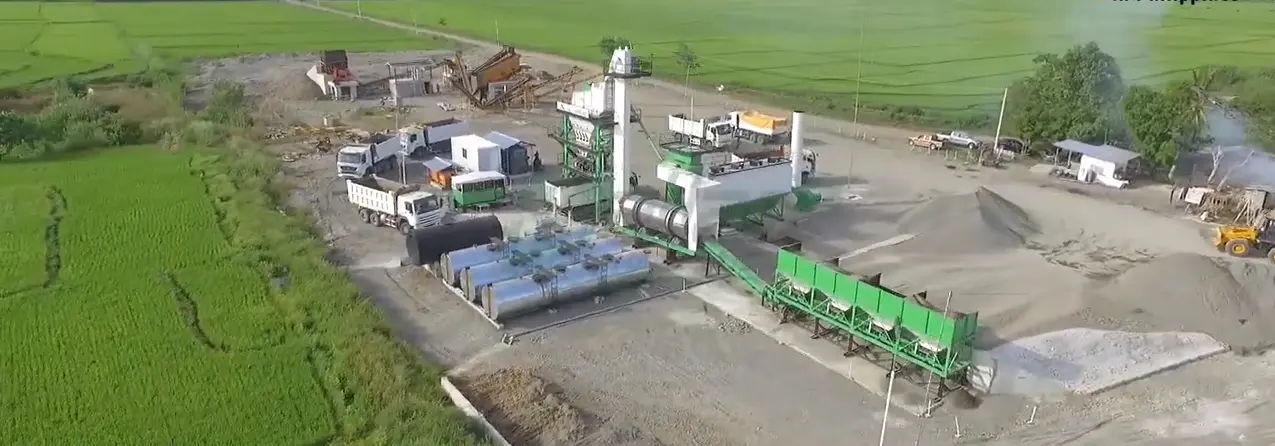
When a road contractor in the Philippines places an order for a 160 TPH asphalt batching plant from a manufacturer in Gujarat, India, the equipment is only half the decision. The other half is everything that happens between the factory gate and the first tonne of hot mix rolling off the plant.
Atlas Technologies Pvt. Ltd., headquartered in Mehsana, Gujarat, India, has supplied asphalt batching plants to the Philippines across multiple projects including the Lubang air project in Occidental Mindoro province and DPWH highway contracts in Luzon. This is the account of what we ship, how it arrives, how it gets commissioned, and what the contractor gets on day one of production.
What Type of Asphalt Plant Does Atlas Supply for the Philippines?
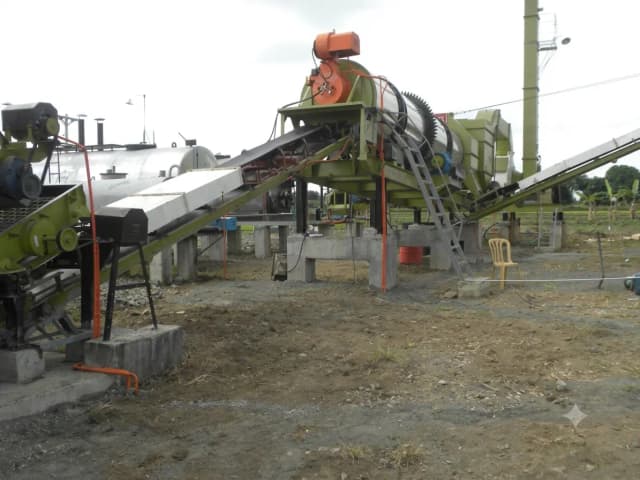
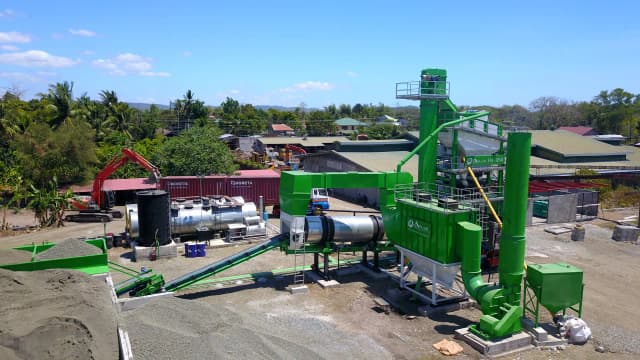
The 160 TPH asphalt batching plant supplied to the Philippines is containerised and skid-mounted. That is not a standard configuration — it is a deliberate decision based on how the Philippines works.
Container shipping from Gujarat to the Port of Manila is the most cost-effective route for a plant of this size. Skid-mounting the major components means each unit loads into a standard shipping container without custom crating, clears customs as identifiable equipment rather than loose machinery, and arrives at site in a condition ready for assembly without requiring a heavy crane for repositioning.
The plant is supplied with:
- Four-bin aggregate feeder
- Drying and mixing drum
- Two bitumen tanks
- Modulating burner
- Baghouse filter for pollution control
- Mineral filler system
- PLC control cabin with panel
- Load-out conveyor
Full specifications for the 160 TPH asphalt batching plant — mixer weight, burner configuration, RAP options and PLC specs — are on the product page.
The modulating burner is specified on every Philippines plant because fuel supply in the Philippines is typically LDO or diesel — and a modulating burner with variable flame control gives the operator precise temperature management regardless of which fuel the site has available. The baghouse filter is standard because DPWH requires pollution control equipment on accredited asphalt batching plants.
How Does an Asphalt Plant Ship from India to the Philippines?
The Philippines presents a logistical challenge that most Indian manufacturers underestimate. It is an archipelago of over 7,000 islands. A plant destined for Luzon moves differently from one destined for Occidental Mindoro or a site in Mindanao.
For the 160 TPH deployment, the plant shipped from Mehsana, Gujarat to the Port of Manila. From Manila, the containerised components were transported by road to the project site.
For remote sites — and Atlas has done this specifically for the Lubang air project in Occidental Mindoro province — the plant is assembled on wheels in Manila first before being transported to the final site. This allows the full plant to be road-legal and towable to locations where cranes and heavy transport are unavailable.
The second 160 TPH plant shipped to the Philippines included two bitumen tanks instead of one — a configuration change made based on the contractor's requirement for longer continuous production runs without resupply. Both tanks, the modulating burner, and the baghouse filter cleared customs together, avoiding piecemeal arrivals across multiple weeks.
Evaluating Asphalt Plant Options for Your Next Project?
Our approach as an asphalt manufacturer ensures you work with engineers who understand local conditions, DPWH requirements, and project economics.
Schedule Your Site Assessment →Does Atlas Send Technicians to the Philippines for Installation?
Atlas sends two engineers to every Philippines installation — one mechanical, one electrical. This is not a remote support arrangement. Both engineers travel to the Philippines and remain on-site through the full installation and commissioning process.
The mechanical technician handles physical assembly, alignment, and mechanical calibration. The electrical technician handles wiring, panel connections, PLC calibration, and sensor verification.
On the 160 TPH deployment, commissioning involved calibrating the PLC control panel to the contractor's mix design requirements and verifying that all weigh systems — aggregate, bitumen, mineral filler — were reading accurately before the first batch was produced. The control panel stores multiple mix recipes, so the commissioning phase included loading the contractor's DPWH-specified mix designs and running test batches to verify output consistency. The plant was operational within the contractor's timeline. Highway paving began on schedule.
What Should a Filipino Contractor Check Before Buying an Asphalt Plant from India?
Atlas has supplied asphalt plants to Filipino contractors enough times to know the questions that come first. Before the MDM 45 deployment in Occidental Mindoro, before the portable asphalt plant, before the 160 TPH — the same concerns come up every time.
Warranty. Atlas provides a 12-month warranty on major parts. Spare parts are shipped from Mehsana directly to the Philippines site on a documented basis regardless of geographic distance.
Spare parts availability. Parts for the 160 TPH plant — wear liners, filter bags, burner components, weigh system load cells — are standard across Atlas's Philippines installations, shipped from Gujarat with documentation that makes customs clearance straightforward.
Technician access. Atlas sends engineers to site for installation and commissioning. For post-installation technical issues, direct contact with the Gujarat engineering team is available.
First-time import process. Atlas coordinates with local brokers for customs clearance and ensures all container shipments clear together. The containerised and skid-mounted plant design makes this significantly easier than loose-component alternatives.
Contractors evaluating running costs? Our asphalt plant fuel consumption guide for 2026 covers HSD, LDO and CNG cost comparisons with real data from Indian operations — directly applicable to Philippines projects running on LDO.
What Output Does a 160 TPH Asphalt Plant Deliver on a DPWH Project?
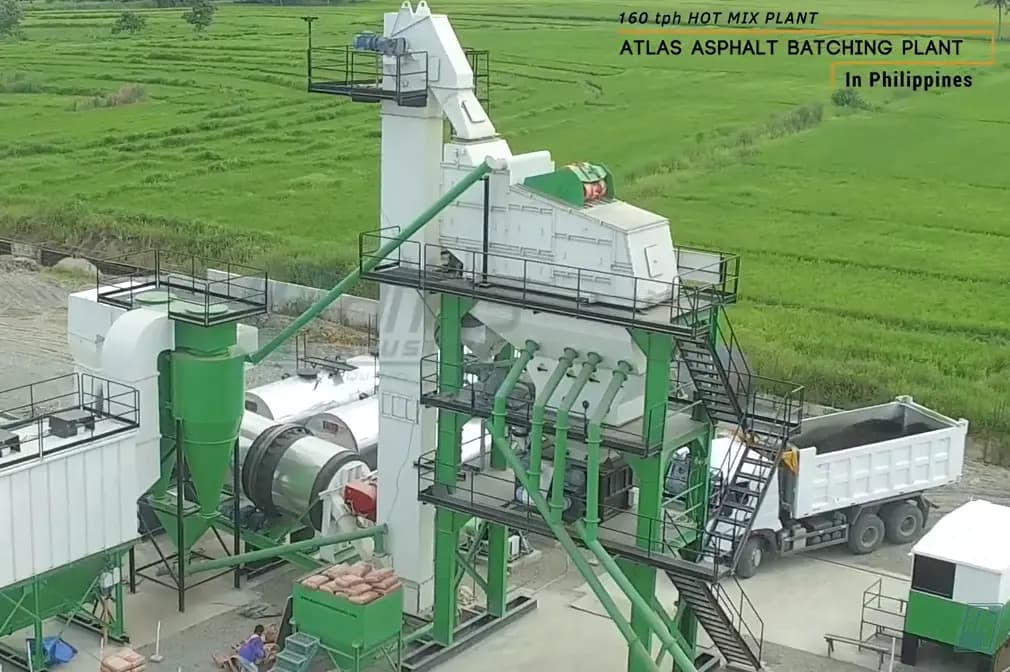
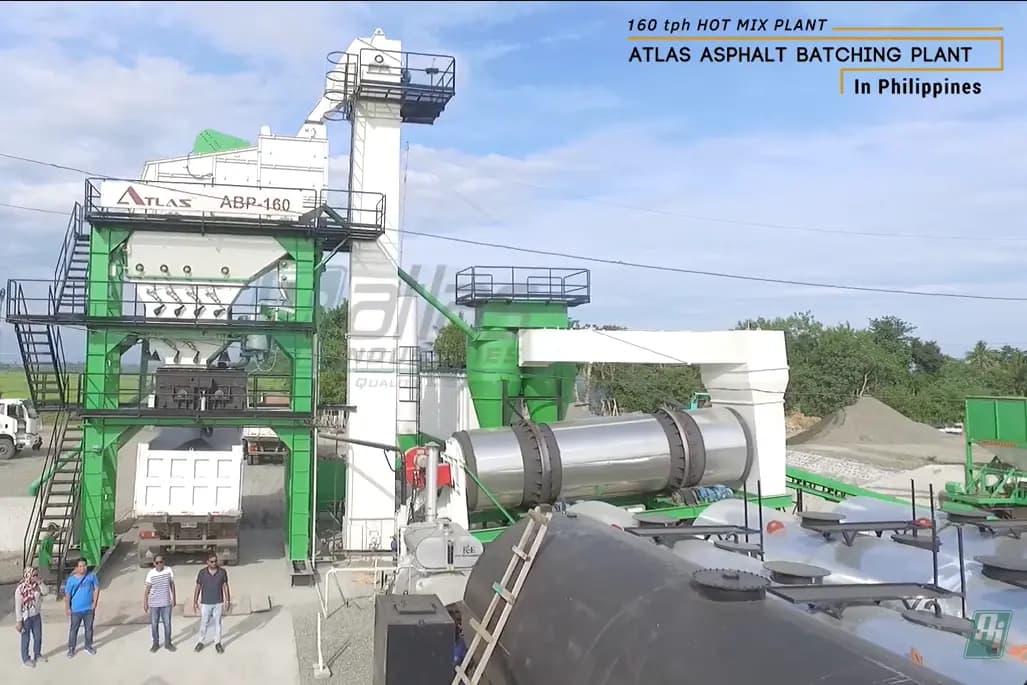
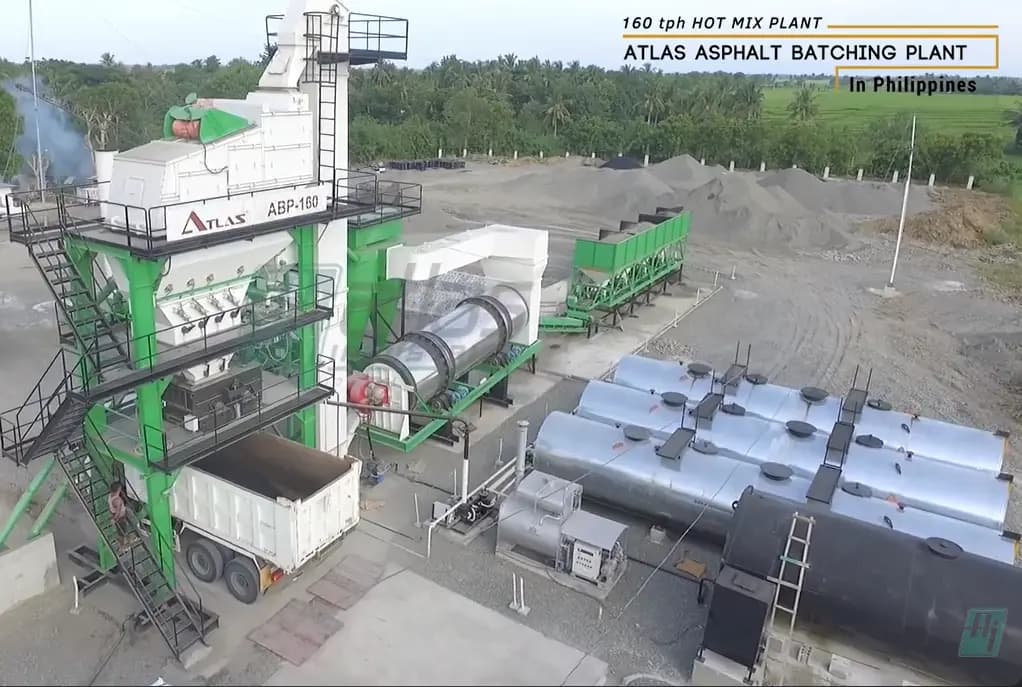
The 160 TPH asphalt batching plant in operation in the Philippines produces 1,280 tonnes of hot mix asphalt in an 8-hour shift. For a DPWH highway contractor, that output covers approximately 2 to 3 kilometres of two-lane highway paving per day — enough to meet aggressive project completion timelines without the plant becoming the bottleneck.
Atlas has supplied multiple asphalt plants to the Philippines across different capacities — the 40–60 TPH mobile drum mix plant in Occidental Mindoro, the 60–90 TPH stationary drum mix plant, the portable asphalt plant for road works, and multiple 160 TPH batching plant deployments. Contractors with remote site requirements or smaller-scale road works can view the full mobile asphalt drum mix plant range covering 40–150 TPH. Each deployment has followed the same model: containerised shipment, on-site engineer deployment, commissioning to DPWH-specified mix designs, and confirmed production before the Atlas team leaves the site.
Planning an Asphalt Plant for a Philippines Project
If you are evaluating an asphalt plant for road works in the Philippines — whether a 160 TPH batching plant for a DPWH highway contract or a smaller mobile unit for a remote site — confirm what the site can take in terms of logistics, confirm what capacity the project requires, and confirm that the manufacturer will put engineers on the ground for commissioning.
Atlas Technologies has done this in Luzon, in Occidental Mindoro, and across other Philippines project locations.
Atlas's stationary asphalt batching plant range covers 80 TPH to 320 TPH — contractors with different project scales or capacity requirements can view the full ABP range here .
Author’s Note
Atlas Technologies Pvt. Ltd. is a road construction equipment manufacturer based in Mehsana, Gujarat, India. Founded in 1986, the company designs and manufactures asphalt batch mix plants, drum mix plants, counter flow plants, wet mix macadam plants, concrete batching plants and road machinery for highway contractors, infrastructure developers and export buyers worldwide.
With over 2,500 installations across 50+ countries and 38 years of manufacturing experience, Atlas Technologies serves projects ranging from national highway construction in India to remote island deployments and large-scale export contracts across Africa, Southeast Asia, the Middle East, East Europe and Oceania Countries.
www.atlastechnologiesindia.com

Mr. Nilesh Patel
Managing Director
Planning Your Next DPWH Highway or Municipal Road Project?
Contact Atlas Technologies to discuss your Philippines project requirements.
Contact Atlas Technologies →Frequently asked
questions.
Dambar Plant vs Drum Mix...
A dambar plant is the commonly used Indian term for...

India Asphalt Pavers Market: Growth,...
India's asphalt pavers market is growing, but equipment decisions shouldn't...

Road Sweeper Machine vs Hydraulic...
Learn the difference between mechanical road sweepers and hydraulic broomers...
Batching Plant: What It Is,...
A batching plant measures, proportions, and processes raw materials according...